

How Shockwave Therapy Works for Erectile Dysfunction
Low-intensity shockwave therapy for erectile dysfunction uses acoustic energy—not electricity—to stimulate tissue in planned penile and pelvic treatment areas. The aim is to support biological responses linked to circulation and erectile function.
The important word is support. Laboratory research suggests several possible mechanisms, but those mechanisms do not prove that treatment will grow new blood vessels, regenerate nerves or permanently reverse ED in every patient.
This guide explains what happens during treatment, what scientists think the acoustic energy may do, what human trials actually show and where uncertainty remains. For the broader evidence, read our shockwave therapy for erectile dysfunction evidence guide.
Why Circulation Matters for Erections
An erection depends on coordinated signals from the brain, nerves, blood vessels, smooth muscle and hormones. During sexual stimulation, nitric-oxide signalling helps the smooth muscle in penile arteries and erectile tissue relax. Blood enters the corpora cavernosa and is temporarily retained, creating rigidity.
Diabetes, high blood pressure, high cholesterol, smoking, cardiovascular disease and ageing can affect endothelial function and circulation. This is called vasculogenic ED. It is common, but it is not the only form of ED. Medication, nerve injury, pelvic surgery, hormonal problems, psychological factors and relationship difficulties may also contribute.
Because ED can have several causes at the same time, reduced blood flow should not be assumed without an assessment. New or worsening ED can also be an early marker of cardiovascular or metabolic disease.
What Is a Medical Shockwave?
A medical shockwave is a brief acoustic pressure pulse. A treatment device generates the pulse and delivers it through an applicator placed against the skin. Conductive gel helps transmit the energy into the targeted tissue.
Low-intensity protocols use energy levels designed for biological stimulation rather than tissue destruction. The treatment is external: there is no incision and no electrical current passes through the penis.
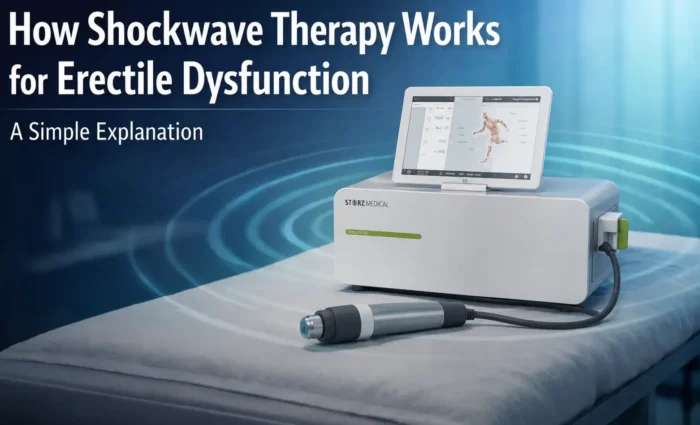
“Focused” and “radial” describe different wave-generation and delivery systems. They are not interchangeable terms. Shockwave Clinic uses the STORZ Medical DUOLITH SD1 with its focused C-ACTOR applicator and urology protocols. Our focused versus radial shockwave guide explains the distinction.
What the Acoustic Energy May Do
Researchers describe the conversion of a mechanical stimulus into cellular signalling as mechanotransduction. In laboratory and animal studies, low-intensity shockwaves have been associated with several responses that could be relevant to erectile tissue.
Endothelial and Nitric-Oxide Signalling
The endothelium is the inner lining of blood vessels. Preclinical studies suggest that acoustic stimulation may influence nitric-oxide pathways and endothelial signalling. These pathways help blood vessels relax and respond during arousal.
Angiogenic Signalling
Laboratory research has reported changes in growth factors involved in blood-vessel formation. This supports a biological hypothesis that shockwaves may encourage microvascular responses. It does not establish that every treated patient grows clinically meaningful new vessels or that ED is cured.
Local Tissue Response
Animal studies have explored possible effects on smooth muscle, connective tissue and nerve-related pathways. These findings help researchers understand potential mechanisms, but results from animal models cannot be presented as proven nerve or tissue regeneration in men.
The most accurate explanation is therefore that low-intensity shockwave therapy may influence biological processes associated with endothelial health, local circulation and tissue responsiveness. The clinical importance of these effects varies between patients.
What Human Clinical Evidence Shows
Randomised trials have compared low-intensity shockwave therapy with sham treatment. Some report improvements in erectile-function scores and erection hardness, particularly in men with mild-to-moderate vasculogenic ED. Other trials show smaller or uncertain differences.
The European Association of Urology guideline concludes that low-intensity shockwave therapy can produce a mild improvement in erectile function in selected vasculogenic patients, but gives only a weak recommendation. A recent Cochrane review of 21 randomised trials found a possible small benefit and rated the certainty of the evidence as low because of inconsistency, imprecision and study limitations.
- Devices, energy settings, pulse counts and treatment schedules differ between studies.
- Most trial participants had mild or mild-to-moderate ED.
- Short-term improvement does not prove permanent structural restoration.
- Long-term outcomes and the best protocol remain uncertain.
Shockwave therapy is therefore better described as an evidence-informed option for selected patients—not a guaranteed cure or a replacement for medical assessment.
What Treatment Feels Like
The applicator is moved across planned treatment points while delivering controlled acoustic pulses. Patients commonly describe tapping, pressure, tingling or temporary sensitivity. Treatment is generally well tolerated, but it should not be advertised as completely painless for everyone.
Low-intensity treatment normally requires no anaesthetic, incision or routine recovery period. Temporary redness, tenderness or discomfort may occur. A practitioner should explain the device, treatment points, protocol and expected sensations before starting.
Sessions, Results and Timing
Published protocols vary considerably, so no universal session number or guaranteed response timetable exists. The treatment plan should follow the selected device protocol and the patient’s assessment.
If improvement occurs, it generally develops over weeks rather than during a single session. Changes may include better firmness, greater reliability or improved response to prescription medication. Some men notice little or no meaningful improvement.
No responsible clinic can promise results after a particular session, guarantee that medication will no longer be needed or claim permanent benefit. Follow-up should consider the patient’s experience and, where appropriate, a validated erectile-function score.
Who May Consider Shockwave Therapy?
The strongest rationale is for well-informed men with mild vasculogenic ED. It may also be discussed with selected men who are unsuitable for oral medication, prefer a non-drug option or respond poorly to correctly used PDE5 inhibitors.
It is less likely to address ED caused mainly by severe nerve injury, advanced vascular damage, an untreated hormonal problem or psychological factors alone. These patients may need another treatment or a combined approach.
Read our comparison of non-surgical ED treatments for the roles of tablets, vacuum devices, injections, testosterone treatment and psychosexual support.
How It Fits Within the Clinic Programme
For suitable patients, Shockwave Clinic may combine focused ESWT with other components, including EMTT, PulseVac dynamic dual-wave infrared vacuum therapy, PRP and carboxytherapy. Not every patient needs every component. No published ED trial has established whether adding EMTT improves outcomes beyond ESWT alone; evidence for the full combined protocol is still developing.
The rationale, uncertainties, alternatives and cost should be explained before treatment. Visit our erectile dysfunction assessment and treatment programme or read the evidence review of PRP for erectile dysfunction.
Frequently Asked Questions
Does shockwave therapy use electricity?
No electrical current is delivered through the penis. The device generates acoustic pressure pulses that travel through tissue.
Does it cure erectile dysfunction?
A cure cannot be promised. Selected men may experience a modest improvement, while others may not. The outcome depends on the cause and severity of ED, health factors and the protocol used.
Can it be used with ED medication?
In selected patients, low-intensity shockwave therapy may be used alongside PDE5 medication under medical guidance. Medication should not be reduced or stopped without consulting the prescribing clinician.
How long do results last?
Durability varies and long-term evidence is limited. Health, medication and the underlying cause of ED may change over time, so no fixed duration or permanent result can be guaranteed.
Book a Confidential ED Assessment
Shockwave Clinic offers private assessment in Cape Town and Johannesburg. We will discuss possible causes, established treatment options and whether focused low-intensity shockwave therapy is appropriate for you.
Request a confidential appointment or review the ED treatment programme.
This article provides general health information and does not replace an individual diagnosis or medical advice. Treatment suitability and outcomes vary.


